
On this page11 sections
Key takeaways
- Find My Profession charges $3,000 a month, or $1,500 a month plus 8% of your first-year salary: same service either way, per its own pricing page (checked November 2026).
- Scale.jobs sells one-time packages of 250 to 1,100 human-submitted applications for $199 to $1,099, with no subscription.
- Careerify's benchmark of 100,000+ self-reported assisted applications puts interview rates at 3–6%, versus roughly 2–3% for cold applying.
- Check for a public service page, pricing, and independent reviews before paying a reverse recruiter.
- LinkedIn's User Agreement (section 8.2) bans bots and unauthorized automated applying. The main reason human-run services advertise themselves as the safer route.
Find My Profession, Scale.jobs, Careerify, My Personal Recruiter, and iCareerSolutions offer managed job search services. Some sell a fixed batch of applications. Others charge a monthly fee for a search that includes outreach and interview preparation.
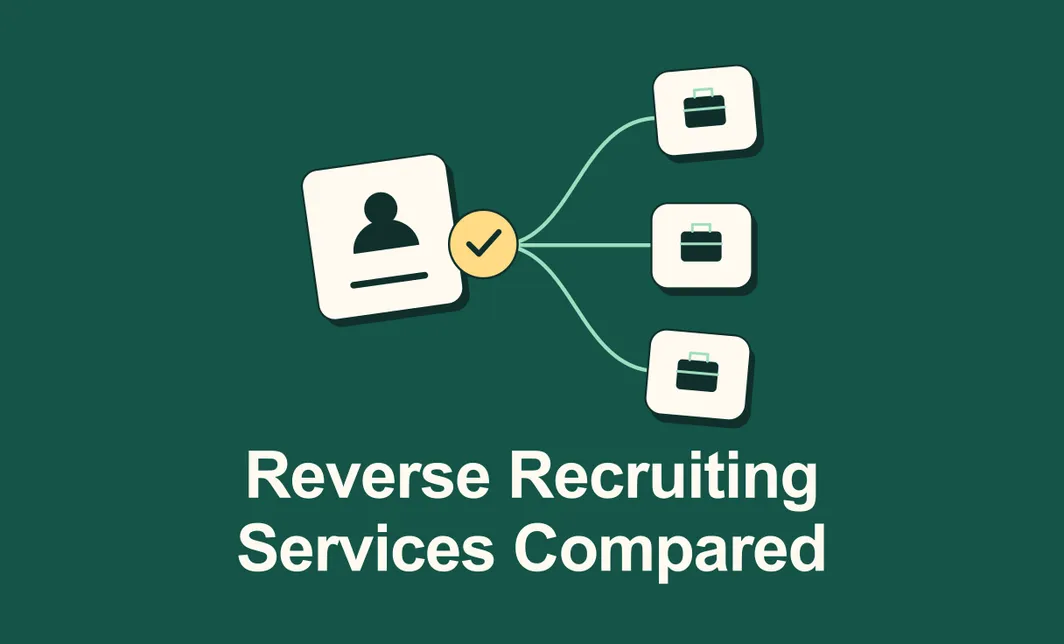
A reverse recruiter works for the job seeker. Depending on the service, they find openings, submit applications, and contact employers on your behalf.
How reverse recruiting works
You hand over your resume, target roles, and (usually) job board credentials. The service’s staff then spend their hours searching listings, tailoring your resume, and submitting applications under your name. Most also do recruiter outreach and follow-ups.
Where it stops matters. None of these services will interview for you, and none can force an employer to call back. As Lifehacker put it back in 2024, the fee doesn’t fix weak positioning or rough interview skills.
How to check a reverse recruiter’s track record
Check whether the provider has a public service page, a price list, and reviews from sources other than its own website.
- HireKicker has no service or pricing page cited here.
- Career Wolf has no service or pricing page cited here.
- JobSprint: the only real match is Generation USA’s free job-search program, a training accelerator, not someone applying for you.
- “Your Corporate Recruiter” has no independent reviews cited here.
- Jobs By Mark / MarkImage has no independent reviews cited here.
- Scowter has a service page but gives no public price.
- Otta / Welcome to the Jungle: exists, but it’s a curated job-matching board. Nobody there applies for you.
A discussion in r/jobsearchhacks also raises a question worth asking directly: who will handle your search, and what recruiting experience do they have?
Five reverse recruiting services compared
| Service | Price (Nov 2026) | What’s included | Applications promised | Third-party reviews | Best for |
|---|---|---|---|---|---|
| Find My Profession | $3,000/mo flat, or $1,500/mo + 8% of first-year salary | Full managed search: strategy, applications, LinkedIn networking outreach, interview prep | Not published | Trustpilot ≈4.8 (~785 reviews); BBB A+, 3 complaints in 3 years | Senior professionals who want a fully managed search |
| Scale.jobs | $199–$1,099 one-time, no subscription | Human assistants fill applications, custom cover letters; proof screenshot per application | 250–1,100 per package | Trustpilot 4.5 (252 reviews) | Budget-conscious volume applying |
| Careerify | $150–$720/mo | Dedicated recruiter hours, cover letter/resume/LinkedIn rewrites on higher plans | ~50–300/mo (1 hour ≈ 5 applications) | No rating cited | Monthly commitment with a delivery guarantee |
| My Personal Recruiter | $899–$2,499/mo | Dedicated recruiter, applications, hiring-manager outreach, resume/LinkedIn strategy | Not published | No rating cited | Executives earning $100K+ |
| iCareerSolutions | $2,995/mo, capped at 4 payments ($11,980 max) | Named reverse recruiter, applications, outreach, interview coaching, weekly KPI report | Quota set at kickoff; not published | No rating cited | Manager-to-C-suite searches |
Review totals for Find My Profession and Scale.jobs are snapshots. Check the dates and read comments about the specific service you are considering.
A sixth company, WeAreCareer, also has a verifiable site with published pricing, $4,000–$6,000 upfront plus a 3–4% success fee. Its site provides customer testimonials.
What each service includes
Two pricing models dominate, and they buy different things.
Monthly retainers (Find My Profession, My Personal Recruiter, iCareerSolutions) buy a team and a process, not a count of applications. Find My Profession lists the same services under its $3,000 monthly plan and its success-fee plan: job search strategy, application management, networking outreach, and interview prep. iCareerSolutions publishes no application quota. It sets activity targets at kickoff and sends a weekly KPI report instead.
Application packages (Scale.jobs, Careerify) buy a specific number of submissions. Scale.jobs’ $399 tier promises 1,000 applications from two human assistants, each with a proof screenshot. Careerify converts recruiter hours into roughly five applications per hour, from about 50 a month on Starter to 300 on Executive. These are “someone apply to jobs for me” on a meter.
The other axis is apply-only versus outreach. Scale.jobs and Careerify mostly apply. Find My Profession, My Personal Recruiter, and iCareerSolutions add LinkedIn networking and hiring-manager outreach. Careerify’s own benchmark data hints why outreach matters. If your problem is volume, buy volume. If your problem is nobody responding, apply-only won’t fix it.
Across 100,000+ self-reported assisted applications, Careerify’s benchmark puts interview rates at 3–6% and offer rates at 0.5–1.5%, against a cold-application baseline of roughly 2–3% interviews. The company itself calls the comparison observational, not a controlled study.
Also read the fine print on “we find jobs.” Scale.jobs’ base packages assume you feed it job leads; its “We Find Jobs” sourcing add-on costs $99–$199 more depending on tier. A $199 plan that requires your own job list is a different product than it first looks.
Flat fees and success fees
Here’s the structural problem, and it’s simple: a service paid per application makes money whether or not those applications fit you. Every extra submission is margin. The honest vendors manage this; the incentive still exists.
Find My Profession shows how its success-fee option works. At a $300,000 salary, the success-based route totals roughly $30,000 ($1,500 a month for four months plus 8% of first-year salary). At $100,000, it’s about $14,000. The page itself notes most professionals earning $150k or more save money on the flat fee.
Success fees also reshape behavior in subtler ways. A company that earns 8–10% of your first-year salary has a reason to push you toward bigger offers and away from quick ones. Ask directly how they decide which roles to target, and who owns the decision.
Find My Profession’s founder, Mike Podesto, has been on both sides of litigation with critics, a 2019 Florida federal docket (Weiner v. Podesto) shows a dispute with a competing resume writer that ended in a stipulated dismissal with prejudice, and a 2025 docket (Podesto v. Svei) shows him suing a career-industry figure over her statements, with a motion to dismiss pending at the time covered here. Docket records are allegations and procedural history, not findings of wrongdoing. But when a founder litigates against critics, read negative reviews and legal threats with extra care before concluding anything either way.
One more disclosure: the National Reverse Recruiter Association, which publishes buyer guidance for this industry, was founded by Arno Markus, who also runs iCareerSolutions, one of the firms it certifies. The association’s red-flag checklist is genuinely useful. Just remember who wrote it.
Humans, bots, and LinkedIn’s rules
If a service offers to apply on LinkedIn for you, ask one question first: is a human clicking, or is a bot?
LinkedIn’s User Agreement, section 8.2 prohibits users from “us[ing] bots or other unauthorized automated methods to access the Services” (including to send messages or add contacts) and separately bans developing or supporting “software, devices, scripts, robots” that scrape or automate the platform. Breaching it can get your account restricted, suspended, or terminated.
A service may use staff to fill in applications by hand. Auto-apply tools use software, and LinkedIn’s rules restrict unauthorized automation. Ask how the service submits applications and whether it needs access to your account.
The catch nobody advertises: human services still operate your accounts, usually with your credentials, with your consent. You remain responsible for anything submitted in your name. If a service offers to falsify dates or inflate titles, walk away. The application carries your name, and the damage lands on you.
How to read reverse recruiting reviews
Look for recurring comments about applications, refunds, and communication.
Real review profiles look lived-in: dates spread over years, a mix of praise and complaints, responses to the complaints. Suspicious profiles show a burst of similar five-star reviews in a short window, generic wording with no service detail, and no critical reviews at all. Read a range of reviews and look for details you can verify. Trustpilot’s own guidance lets you flag reviews that look off, and it publishes review timing on every profile. Use that timing.
The reverse direction matters too. A r/jobsearchhacks guide concluded that reverse recruiting isn’t inherently a scam but warned readers to “be careful of the snake oil”. Complaints in these threads cluster around months of fees with no interviews and applications that ignored the candidate’s targeting criteria. And a LinkedIn post by career expert Sarah Johnston called the trend’s marketing predatory, arguing there’s no secret database of hidden jobs. You don’t have to agree with her to take the point: nobody has exclusive access to the job market. If a pitch implies otherwise, that’s your answer.
Nine questions to ask before you pay
Get the answers in writing before you sign a contract.
- Who exactly applies, and how? A named human on staff, or a script? If a tool touches your LinkedIn, section 8.2 risk is yours, not theirs.
- How many applications per month, and where? Vague answers (“as many as needed”) hide both spray-and-pray and underdelivery.
- Can I see proof of each application? Scale.jobs builds screenshots into its pitch. Every vendor should match that standard.
- Do you tailor each resume, or blast one? Ask for two sample applications before you pay anything.
- What happens if there are no interviews in 60 days? Real answers involve renegotiation, re-targeting, or refunds, not “trust the process.”
- Is any guarantee in the contract? Find My Profession ties its six-month guarantee to an offer or five qualified interviews; iCareerSolutions guarantees five qualified interviews in four months. Verbal promises are worthless.
- Whose account credentials do you use, and how are they stored? You’re liable for what’s submitted in your name.
- What’s your refund policy at each point in the contract? Scale.jobs pro-rata-refunds unused credits; some retainers are nonrefundable from day one.
- Can I speak to a past client? Reviews can be farmed. A fifteen-minute call with a real customer can’t.
How to compare the cost with your current search
Reverse recruiting is expensive because humans doing careful work are expensive. If that math doesn’t work for you, two cheaper approximations exist.
AI auto-apply tools (LazyApply, Simplify, and similar) run a few dollars to about $200 a month. They’re real software with real trade-offs: bots skip career portals they can’t parse, and anything that automates LinkedIn risks your account under that section 8.2 clause. If you go this route, treat it as autofill with oversight, not a strategy.
The other option is hiring a general virtual assistant on a freelance platform, paid hourly, to send applications you’ve already chosen. You keep targeting control and pay for execution only. It’s the same labor minus the branding, and minus the accountability a real firm supposedly provides. You’ll be the manager.
FAQ
Can I pay someone to apply to jobs for me? Yes, and it’s legal. Companies like Careerify and Scale.jobs exist for exactly this, and freelancers do it too. What you can’t outsource is accountability. Anything submitted under your name is your resume and your claim.
How much does a reverse recruiter cost? In November 2026, verified prices ran from $199 one-time (Scale.jobs’ basic package) to $3,000 a month (Find My Profession, iCareerSolutions). A 2026 industry survey of 18 providers put median monthly pricing around $1,500, though note that survey comes from an association founded by a service provider.
Is reverse recruiting worth it? Depends on your bottleneck. If you lack hours, it buys them back. If your applications already convert and interviews still stall out, paying for volume won’t fix conversion. Interview prep will. Careerify’s benchmark data (3–6% assisted interview rates, self-reported) suggests a modest edge over cold applying, not a shortcut.
Will LinkedIn ban me if a service applies for me? LinkedIn’s User Agreement section 8.2 bans bots and unauthorized automated methods on the platform, with account restriction or termination on the table. A human manually applying is different from a bot in how the rules are written, but you’re still responsible for how your account is used. Ask any vendor exactly how they access it.
What’s the difference between a reverse recruiter and a career coach? A coach advises you and you do the work; a reverse recruiter does the work and you review it. Coaches typically charge per session, while reverse recruiting runs monthly retainers or application packages. Many job seekers need the first, not the second.
How do I spot a fake reverse recruiting service? Look for guaranteed outcomes, pressure to pay before a written contract, no legal business name, and a review profile where every review is five stars posted in the same few months. Two or three of those at once is a walk-away, per the industry association’s own red-flag list.
Do these services guarantee a job? No credible one guarantees a job outright. Find My Profession guarantees an offer or five qualified interviews within six months or additional free months; iCareerSolutions guarantees five qualified interviews in four months or continued work free. Those are work-and-interview guarantees. Anyone promising you a job is selling something else.
Sources
Vendor pricing and service pages
- Find My Profession: Reverse Recruiting (pricing, guarantee, service claims)
- Scale.jobs: Pricing
- Careerify: Pricing
- Careerify: Job Search Benchmark
- My Personal Recruiter
- iCareerSolutions: Reverse Recruiting Pricing
- WeAreCareer: Reverse Recruiting Services
- Scowter: Reverse Recruiting (checked; no public pricing)
Review and complaint records
- Find My Profession: Trustpilot
- Scale.jobs: Trustpilot (seen via search)
- Find My Profession: BBB profile
- Trustpilot: flagging reviews
- Reddit: r/jobsearchhacks guide to avoiding scams
- Reddit: “Worth it to use a reverse recruiter?”
- Sarah Johnston: LinkedIn post on reverse recruiting marketing
Legal and policy
- LinkedIn User Agreement (section 8.2)
- Justia docket: Weiner v. Podesto (S.D. Fla., 2019) (seen via search)
- Justia docket: Podesto v. Svei (filed 2025) (seen via search)
Industry commentary and context
- Lifehacker: Why You Should Avoid “Reverse Recruiters” (seen via search)
- National Reverse Recruiter Association: red flags page
- State of Reverse Recruiting 2026: 18-provider fee survey (seen via search)
- Welcome to the Jungle (formerly Otta) (checked; job-matching board, not an application service)
About this article
Written by ResumeFlex. Questions or corrections? Contact ResumeFlex. Read our source and correction standards.
Filed under
Job Search